
|
||||||||||||||||||||||||||||||||||||||||||||||||||||||||||||||||||||||||||||||||||||||||||||||||||||||||
|
 |
|||||||||||||||||||||||||||||||||||||||||||||||||||||||||||||||||||||||||||||||||||||||||||||||||||||||

























|
Black Cats HelicoptersLynx HAS.Mk.3
In June 1990 three Royal Navy Lynx HAS.Mk.3’s,ZF557,ZF558 and ZF563 were fitted with the CTS and entered service with No.700L squadron,The RN Lynx Operational Flight Trials Unit (LOFTO), at RNAS Portland on the 6th July for initial sea trials in HMS Argus. These were completed in August and more CTS-equiped Lynx were scheduled to join the squadron for furher trials during early 1991 as aaprt of the Lynx Mk.8 development programme. Three more Lynx Mk.3’s were allocated to this programme at Yeovil; XZ236,originally a Lynx HAS.2 which ultimatley, was converted to Mk.8 standard and was involved in the avionics systems development,ZD266 was used for CTS development and intergrationwith existing equipment and further enhancements for ECM, MAD and other equipment. ZD267 was extensively modified to incorporate a new passive identification device,having the nose re-configured and radar aerials and other equipment re-located.The all-up weight was increased to11,300lb,reverse direction tail rotor, and the Sea Spray 180 degree radar re-positioned in a chin-mounted radome. It went to the A&AEE during mid-1990 for testing the Mk.8 airframe, and was also used for flight testing advanced composite rotor blades with anhedral tips developed from the BERP composite blades.
Lynx HAS.Mk.8
They embark in their ship whenever it sails. Able to fire the Sea Skua anti-surface missile, which proved highly effective during the Gulf war, the Lynx forms an integral part of the ships detection and weapon system and can project the influence of a ship over great distances with the key element of surprise. In addition to the Sea Skua the Lynx has the Sting Ray torpedo and the older technology, but nevertheless most effective depth charge for anti-submarine warfare. The aircraft may also be fitted with a machine gun pod. The home base for all seaborne Lynx is the Royal Naval Air Station Yeovilton in Somerset. A second variant of the Lynx is in service with the Royal Navy. The attack/utility version is operated in support of the Royal Marines in conjunction with the Commando Sea King. It fires the TOW anti-armour missile and gives an autonomous and flexible response against tanks and armoured personnel carriers to the Land Force Commander during Amphibious Operations.
|
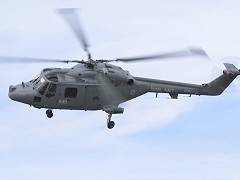 Basically
similar to the Lynx HAS.Mk.2,the HAS.Mk.3 is powered by two 1,120 shp
Gem 41-1 turboshaft engines with an uprated transmissionto permit the
all-up weight to incerase to 10,500lb. These aircraft have the ‘three-pinion’
main gearboxes with a torque-sharing device built in wich permitted
much greater single-engine power inputs from the up-rated enginesin
an emergency; these offerd an improved saftey margin for a flyaway following
an engine failure. A total of twenty aircraft were ordered but when
three Lynx HAS.Mk.2 were lost in the Falklands when HMS Antelope
and Coventry and the conveyor ship Atlantic Conveyor
were destroyed, three more HAS.Mk.3’s were ordered as replacements plus
one for the ETPS. Deliveries began in March 1982 and were completed
by April 1985, but in July, a further seven aircraft were ordered.In
May it had been revealed that Westland, with Racal Avionics as a sub-contractor,was
developing a Racal-designed central tactial system (CTS) for the HAS.Mk.3
to reduce the crew’s workload in future Lynx variants.
Basically
similar to the Lynx HAS.Mk.2,the HAS.Mk.3 is powered by two 1,120 shp
Gem 41-1 turboshaft engines with an uprated transmissionto permit the
all-up weight to incerase to 10,500lb. These aircraft have the ‘three-pinion’
main gearboxes with a torque-sharing device built in wich permitted
much greater single-engine power inputs from the up-rated enginesin
an emergency; these offerd an improved saftey margin for a flyaway following
an engine failure. A total of twenty aircraft were ordered but when
three Lynx HAS.Mk.2 were lost in the Falklands when HMS Antelope
and Coventry and the conveyor ship Atlantic Conveyor
were destroyed, three more HAS.Mk.3’s were ordered as replacements plus
one for the ETPS. Deliveries began in March 1982 and were completed
by April 1985, but in July, a further seven aircraft were ordered.In
May it had been revealed that Westland, with Racal Avionics as a sub-contractor,was
developing a Racal-designed central tactial system (CTS) for the HAS.Mk.3
to reduce the crew’s workload in future Lynx variants.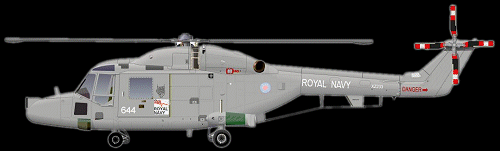
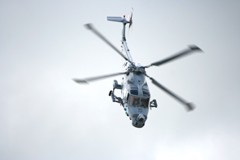 Primarily
an anti-surface and anti-submarine helicopter designed to operate from
frigates and destroyers of the Fleet, this fast and capable aircraft
has recently been updated to the Mk8 standard, which is now in service
throughout the Fleet. The aircraft is being fitted with a very advanced
Central Tactical System and Passive Identification Device in addition
to the equipment currently fitted. Each independent flight comprises
a pilot, an observer and a team of 7 maintainers.
Primarily
an anti-surface and anti-submarine helicopter designed to operate from
frigates and destroyers of the Fleet, this fast and capable aircraft
has recently been updated to the Mk8 standard, which is now in service
throughout the Fleet. The aircraft is being fitted with a very advanced
Central Tactical System and Passive Identification Device in addition
to the equipment currently fitted. Each independent flight comprises
a pilot, an observer and a team of 7 maintainers. 