| |
Gazelle
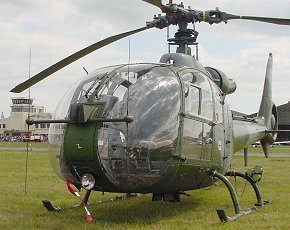 The Gazelle, was produced as part of an Anglo-French venture between
Westland and Aerospatiale in1968. The prototype flew for the first time
on 7 April 1967. Still one of the fastest helicopters ever built (with
a maximum speed of 193 mph), it served with all four branches of the British
armed forces – RAF, Royal Navy, Army and Royal Marines – filling a variety
of roles. Four versions of the Gazelle were used by the British Forces.
The SA341D became the Gazelle HT3 in RAF service, and was equipped as
a helicopter pilot trainer. The first was delivered on 17 July 1973. The
SA341E was used for communications duties and VIP transport and was designated
Gazelle HCC4. The SA 341C was also purchased for the British Armed Forces
as a pilot trainer for the Royal Navy. The SA 341B was equipped to a specification
for the Army Air Corps. Designated Gazelle AH Mk 1, the first aircraft
entered service in 1973. Since that time it has been used with major success
in every theatre in which the British Army has served, from it’s amphibious
role in the battle for the Falkland Islands to deserts of Kuwait and
Iraq to the mountains of the more recent Kosovo campaign. In French ALAT
service, variants are also equipped with the Mistrale Air to Air missile
and the 20mm cannon. This year marks the Gazelle’s 28th year of continuous
British Army service. The Gazelle, was produced as part of an Anglo-French venture between
Westland and Aerospatiale in1968. The prototype flew for the first time
on 7 April 1967. Still one of the fastest helicopters ever built (with
a maximum speed of 193 mph), it served with all four branches of the British
armed forces – RAF, Royal Navy, Army and Royal Marines – filling a variety
of roles. Four versions of the Gazelle were used by the British Forces.
The SA341D became the Gazelle HT3 in RAF service, and was equipped as
a helicopter pilot trainer. The first was delivered on 17 July 1973. The
SA341E was used for communications duties and VIP transport and was designated
Gazelle HCC4. The SA 341C was also purchased for the British Armed Forces
as a pilot trainer for the Royal Navy. The SA 341B was equipped to a specification
for the Army Air Corps. Designated Gazelle AH Mk 1, the first aircraft
entered service in 1973. Since that time it has been used with major success
in every theatre in which the British Army has served, from it’s amphibious
role in the battle for the Falkland Islands to deserts of Kuwait and
Iraq to the mountains of the more recent Kosovo campaign. In French ALAT
service, variants are also equipped with the Mistrale Air to Air missile
and the 20mm cannon. This year marks the Gazelle’s 28th year of continuous
British Army service.
Lynx
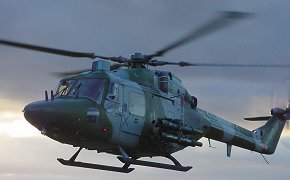 The
Lynx has been the subject of a continuous development and modification
programme. It is one of the most successful light anti shipping/submarine
helicopters and has been exported to many foreign countries. In British
Army service it was equipped with a skid type undercarriage to facilitate
it’s use on the plains of Northwest Europe. Due to it’s cutting edge technology
semi- rigid titanium rotor head the aircraft is superbly manoeuvreable
and is adaptable to a wide variety of missions. Originally, 113 Lynx AH
Mk 1s were supplied to the Army Air Corps as a multi role helicopter.
During the ‘cold war’ it’s primary job was in the anti-tank role, it’s
ability to carry 8 TOW anti-tank missiles plus a further 8 in the cabin
as a reload gave military commanders a major improvement in capability
over the Scout AH1 that it replaced. In 1985, an engine and transmission
upgrade programme began. These modifications, incorporated the now trademark
BERP rotor system and resulted in the Lynx AH 7, eleven new build Mk 7s
were delivered by July 1987. The Mk 7 was a response to General Staff
Requirement 3947 and was specifically configured to improve extended duration
hover performance, vital to the Lynx’s primary anti-tank role. Aside from
the eleven new aircraft, work began on converting existing Mk 1 aircraft
to this standard. In 1987, in order to reduce it’s infra red signature,
exhaust suppression baffles were added, all Lynx that took part in Operation
Desert Storm were equipped with these baffles in addition to a particle
separation sand filter system. The
Lynx has been the subject of a continuous development and modification
programme. It is one of the most successful light anti shipping/submarine
helicopters and has been exported to many foreign countries. In British
Army service it was equipped with a skid type undercarriage to facilitate
it’s use on the plains of Northwest Europe. Due to it’s cutting edge technology
semi- rigid titanium rotor head the aircraft is superbly manoeuvreable
and is adaptable to a wide variety of missions. Originally, 113 Lynx AH
Mk 1s were supplied to the Army Air Corps as a multi role helicopter.
During the ‘cold war’ it’s primary job was in the anti-tank role, it’s
ability to carry 8 TOW anti-tank missiles plus a further 8 in the cabin
as a reload gave military commanders a major improvement in capability
over the Scout AH1 that it replaced. In 1985, an engine and transmission
upgrade programme began. These modifications, incorporated the now trademark
BERP rotor system and resulted in the Lynx AH 7, eleven new build Mk 7s
were delivered by July 1987. The Mk 7 was a response to General Staff
Requirement 3947 and was specifically configured to improve extended duration
hover performance, vital to the Lynx’s primary anti-tank role. Aside from
the eleven new aircraft, work began on converting existing Mk 1 aircraft
to this standard. In 1987, in order to reduce it’s infra red signature,
exhaust suppression baffles were added, all Lynx that took part in Operation
Desert Storm were equipped with these baffles in addition to a particle
separation sand filter system.
The latest Lynx in UK
Army Air Corps service is the AH Mk 9, easily identifiable by its tricycle
undercarriage, this version is designed as a Light Battlefield Helicopter
and is an integral part of the hard hitting new 16th Air Assault Brigade.
|
|


